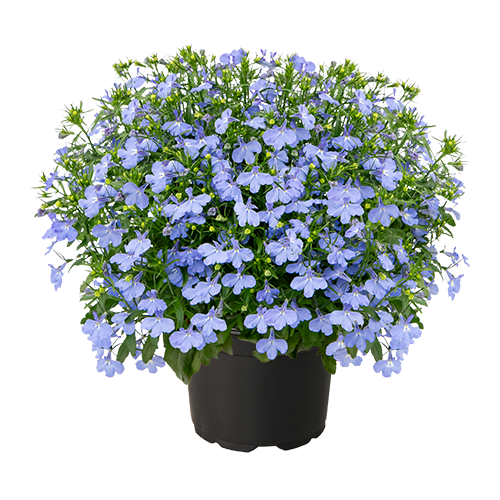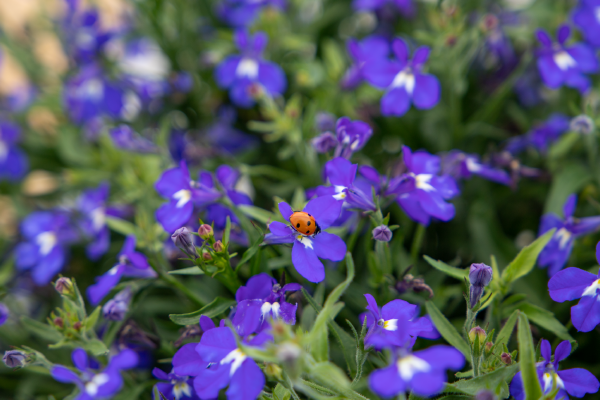
Masterpiece Blue with Eye
Item no.: LE0201P- Excellent heat tolerance and impressive field performance
- Early flowering with large flowers
- Well-branched, mounding growth
- Perfect for pot and container production


- Crop Time
- Spring: 12 - 14 weeks
- Height ∅
- 12 ″ / 30 cm
- Width ∅
- 16 ″ / 40 cm
- Exposure
- Sun - Partial shade
- Seed Form
- Pelleted Seed
- Product Use
- Pots, Containers, Hanging Baskets, Landscape
- Family, Origin
- Campanulaceae, South and Central Africa
- Minimum Germ. Rate
- 80%
Technical Guide
Flowering Type: Facultative long day plant. Under long days above 12 hours with a higher light intensity, the plants will initiate and flower more quickly. The crop time will be shorter.
Flowering Mechanism: Flowering is affected by day-length, irradiance and temperature. A rather dry cultivation promotes floriferousness.
Germination: Optimum conditions for seedling development, beginning on the day of sowing until radicle emergence. Expect radicle emergence in 4-7 days.
Sowing method: 4-5 pellets per plug, depending on time of cultivation.
Media: pH 5.8-6.2; EC 0.5-0.75
Cover: Light is required for germination -no covering.
Temperature: 20-22 °C (68-72 °F) (68-72 °F) for days 1-7. For irrigation use warm water above 15 °C (59 °F) only.
Moisture: Begin with a wet (4) for the first 10 days and on day 11 begin to dry them back slightly to moist (3). This will help in the seedlings rooting into the media. On day 21 it is critical to begin a good wet to dry cycle to prevent algae growth and help with the uptake of nutrients. At this point you can alternate between a moist (3) and a medium (2). Good ventilation and horizontal airflow will create such an environment.
Humidity: 95‑100 % until day 7; then reduce to 40‑60 %.
Media: pH 5.5‑5.8; EC 0.8‑1.4.
Light: Protect the seedlings from direct sunlight until they are well established. Lobelias are facultative long day plants, so a longer day length and higher light levels will promote early flowering. Supplemental lighting of 1,000‑1,500 ft. candles (10,800‑26,900 lx) during the first days after root development reduces stretching and improves plant quality.
Fertilizer: Start the first fertilization approximately two weeks after sowing to prevent deficiency symptoms. Maintain an EC < 0.8 and begin feeding with less than 100 ppm nitrogen. Increase fertilization in the second part of the plug time up to 100‑ 175 ppm nitrogen with an EC of 1.2‑1.4. Use a complete balanced fertilizer such as 15‑5‑15.
Growth Regulators: No growth regulators are required in the plug stage.
Temperature: After germination, grow at temperatures of 20‑22 °C (68‑72 °F), day and night. After development of the roots, the temperature can be further decreased to 18‑20 °C (64‑68 °F). Lower temperatures promote plant compactness and reduce the need of PGR.
Media: pH 5.8-6.2; EC 1.25-1.5.
Light: A longer day length and higher light levels will promote early flowering. Under short days below 11 hours, the plants will grow vegatative.
Temperature: After transplanting, the optimal temperature is 12-14 °C (54-57 °F). At higher temperatures above 16 °C (60 °F), the plants produce larger leaves and dominant shoots. Avoid production with bottom heat. When transplanting later in season, the plants can be grown outdoors.
Moisture: Alternate between moisture levels moist (3) and medium (2). Let plants dry back to at least a medium (2) before re-saturating to a moist (3). Avoid watering plants under high temperature and light when the leaf temperature is excessive. This can cause leaf burn.
Humidity: 40-60 % humidity is ideal. Providing good ventilation and horizontal airflow will help lower the humidity and dry back the media, providing oxygen to the roots.
Fertilizer: Feed the plants weekly with 175-225 ppm nitrogen, using a complete balanced fertilizer such as 15-5-15 or 18-11-18. Maintain an EC between 1.25 and 1.5. Wetness and cold medium temperatures are a cause for iron deficiency. The roots are sensitive to high salt levels in substrate.
Growth Regulators: Applications of B-Nine (daminozide) sprays at 0.2-0.3% as well as soft applications with Bonzi (paclobutrazol) at 0.1% work well. One application of Regalis (prohexadiuon-calcium) at 0.2% at the beginning promotes branching and compactness of plants.
Pinching: Not necessary if enough space is available. When space is limited, plants can be pinched up to three weeks after transplanting without negatively affecting the flowering. For seed varieties, the probability of a virus infection after pinching is low compared to cuttings because you always start "clean". The entire cutting supply chain is vulnerable to viruses due to the required desinfection of knifes in production.
Fungicide: Apply fungicides preventive during wet periods of high humidity and low light levels.
Common Diseases: Botrytis, can be managed with Boscalid 0,1%.
Pests: Primarily aphids and thrips.
The later the season, the shorter the finished crop time.


Moisture Codes
| Saturated (5) | Water is easily observed when finger is pressed on cell. Water moves freely from the top of the plug to the bottom. |
| Wet (4) | Media looks black and is not glistening. The media feels wet to the touch but there is very little water movement. |
| Moist (3) | Water is not easily visible. When finger is pressed on the cell there is very little movement from top to bottom. |
| Medium (2) | Media is not black, but now looks medium brown. There is no water movement when pressed with finger. |
| Dry (1) | Media has changed color to a very light brown and is dry to the touch. |
All information in our technical guide is based on our own trials and would therefore be as guideline only. Detailed cultivation aspects vary depending on climate, location, time of year and environmental conditions. Benary expressly disclaims any responsibility for the content of such data/information and makes no representation or warranty for the cultivation of any products listed. It is recommended that growers conduct a trial of products under their own conditions.